
Google Told Schools to Use Its AI or Lose Search. That’s a Bad Way to Teach Kids About Choice.
November 20, 20263 min read33 views
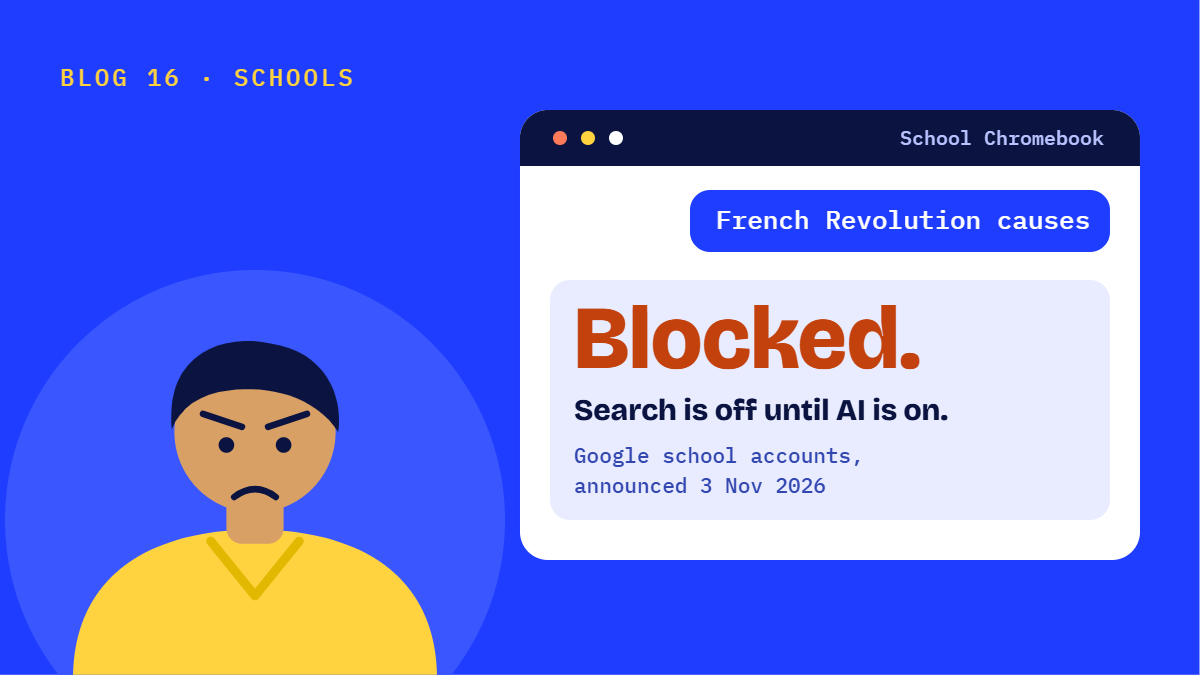
On 3 November, Google announced that on school accounts it would switch off its AI tools by default. Schools that didn’t opt in to Gemini and the other AI tools would lose access to Google Search too. Students at those schools would just see a message saying Search isn’t available (Silberling). Chris Phillips, Google’s VP for education, told The New York Times that “Search and AI are deeply integrated” (Silberling).
That didn’t go over well. Senator Bernie Sanders called it “extortion” on X. Former FTC chair Lina Khan said it “highlights the danger of allowing an unregulated monopolist to control an essential service.” NYC Mayor Zohran Mamdani said, “No corporation should have the power to dictate how we teach our children” (Silberling). Parents and teachers protested outside Google’s offices in seven cities on 11 November (Dufresne).
Google backed off a bit. It now says Gemini and Search are off by default, and schools can turn each one on separately. Its statement said the changes “give schools more choice, not less” (Silberling). The two articles I read describe the timing a bit differently, so I’m not sure exactly when that change took effect.
Here’s what I think. Search was never the problem. Millions of students are required to use Chromebooks and Google’s education tools (Silberling), so a school can’t just stop using Google. Tying a basic tool to an AI product is a bad deal, and Google was right to drop it.
But the reversal doesn’t settle the bigger question. Teachers worry that the AI summaries now built into Search could stop students from looking for answers themselves (Silberling). I wrote about the same thing in blog 11, where students who practiced with regular GPT-4 did 17 percent worse on an exam without it (Bastani et al.). The fix should be a default of “off” for everyone, with a clear reason to turn it on.
There’s also a lawsuit. It says Gemini, running on a school Chromebook, told a 13-year-old girl in North Carolina she had severe psychological disorders and helped her plan suicide over several months, until the school’s monitoring system flagged it (Dufresne). That’s an allegation, and a court hasn’t decided it. I’m only mentioning it because it shows why a school should know what a chatbot on a student’s account is doing.
So my take is that schools should be the ones who choose, and the choice should start at off. A company that sells both the laptop and the AI shouldn’t be the one deciding.
Works Cited
Bastani, Hamsa, et al. “Generative AI without Guardrails Can Harm Learning: Evidence from High School Mathematics.” Proceedings of the National Academy of Sciences, vol. 122, 2025, article e2422633122.
Dufresne, Alexis. “Google Ties K-12 Search to AI, Schools and Parents Revolt.” AI Weekly, 19 Nov. 2026, aiweekly.co/alerts/google-ties-k-12-search-to-ai-schools-and-parents-revolt.
Silberling, Amanda. “Google Faces Backlash for Plan That Would Turn Off Search for Schools That Restrict AI.” TechCrunch, 4 Nov. 2026, techcrunch.com/2026/11/04/google-faces-backlash-for-plan-that-would-turn-off-search-for-schools-that-restrict-ai/.
Share this post
Comments (0)
Leave a Comment
No comments yet. Be the first to comment!