
You Probably Can't Tell What's Real Anymore
A 2025 iProov study found that only 0.1% of people could accurately identify every AI-generated image and video, highlighting the growing challenge of deepfakes and digital trust.
Can You Really Spot an AI Fake?
Try this. Pull up a video online right now and ask yourself honestly whether you could tell if it had been faked by AI. Most people would say yes. Almost nobody actually can.
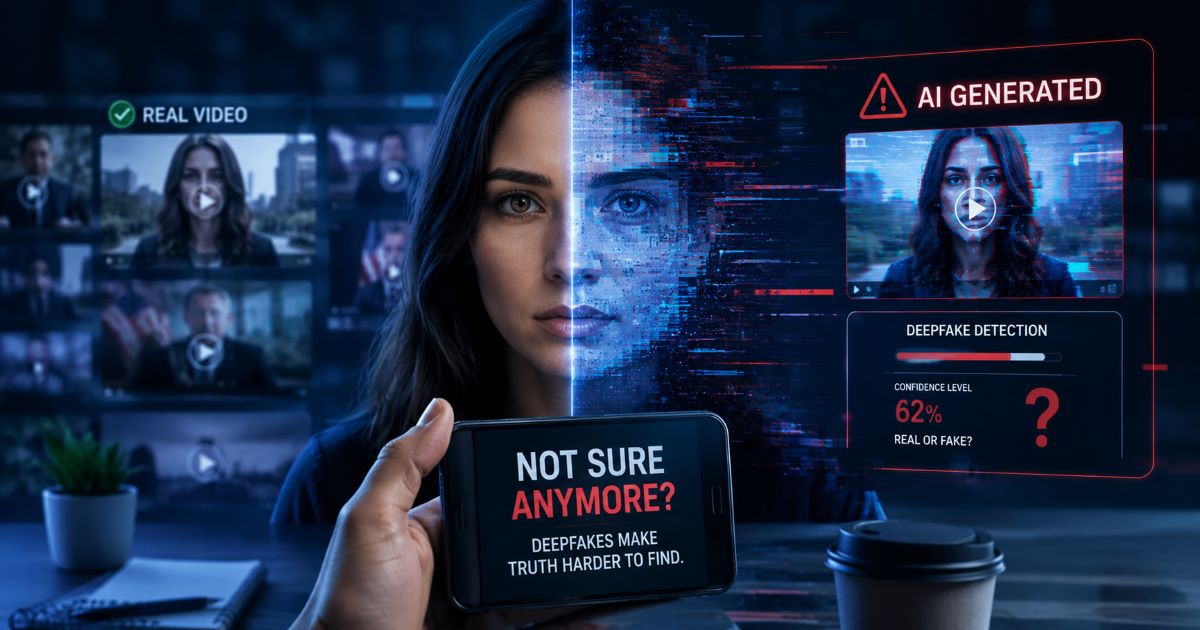
iProov ran a study in 2025 with 2,000 consumers in the UK and US, showing them a mix of real and AI generated images and video, and told them directly to watch for fakes. Only 0.1 percent of participants correctly identified every single one (iProov). Not 0.1 percent got a perfect score by accident on an easy test, this was people who knew going in that some of what they were seeing was fake and still could not consistently spot it. Even worse, the same study found that people stayed around 60 percent confident in their answers whether they were right or wrong. The confidence did not track the accuracy at all.
The Bigger Problem Isn't Just the Deepfakes
This is the part that actually worries me, more than the fakes themselves. A convincing deepfake is a problem. A population that is both bad at detecting fakes and unaware of how bad they are at it is a much bigger one. Once people realize fake video exists and is common, some of them stop trusting real footage too. A politician or public figure caught doing something on camera can just claim it was AI generated, and there is no longer an easy way for the average viewer to prove otherwise. The technology does not even need to be used against you directly to cause damage. Its mere existence gives everyone a built in excuse to deny reality.
Why We Need Better Protection Against AI-Generated Content
I do not think the fix here is telling people to just try harder to spot fakes, because the data already shows that does not work, even when people are actively looking. The fix has to be structural: platforms need to label AI generated content before it spreads, and we need to stop treating video as automatic proof of anything, the same way we already know not to trust every photo we see online. Until that shift actually happens, believing something is real because you watched it happen on screen is no longer a safe assumption.
📚 Works Cited
iProov. "Study Reveals Deepfake Blindspot: Only 0.1% of People Can Accurately Detect AI-Generated Deepfakes." iProov, 12 Feb. 2025, www.iproov.com/press/study-reveals-deepfake-blindspot-detect-ai-generated-content.
Frequently Asked Questions
Share this post
Comments (0)
No comments yet. Be the first to comment!